PIPELINING

Pipelining is the process of accumulating instruction from the processor through a pipeline.
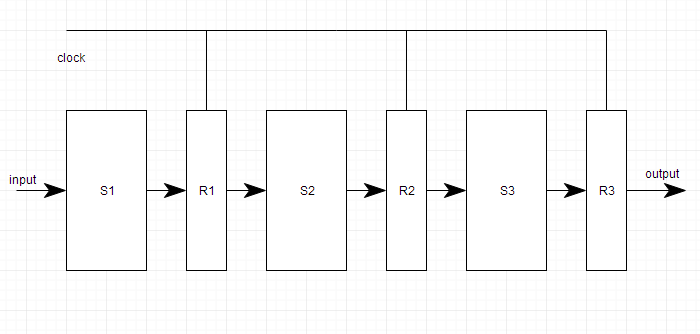

Pipelining is the process of accumulating instruction from the processor through a pipeline.
In computers, a pipeline is the continuous and somewhat overlapped movement of instruction to the processor or in the arithmetic steps taken by the processor to perform an instruction. Pipelining is the use of a pipeline. Without a pipeline, a computer processor gets the first instruction from memory, performs the operation it calls for, and then goes to get the next instruction from memory, and so forth. While fetching (getting) the instruction, the arithmetic part of the processor is idle. It must wait until it gets the next instruction. With pipelining, the computer architecture allows the next instructions to be fetched while the processor is performing arithmetic operations, holding them in a buffer close to the processor until each instruction operation can be performed. The staging of instruction fetching is continuous. The result is an increase in the number of instructions that can be performed during a given time period.
Pipelined Architecture-
In pipelined architecture,
- The hardware of the CPU is split up into several functional units.
- Each functional unit performs a dedicated task.
- The number of functional units may vary from processor to processor.
- These functional units are called as stages of the pipeline.
- Control unit manages all the stages using control signals.
- There is a register associated with each stage that holds the data.
- There is a global clock that synchronizes the working of all the stages.
- At the beginning of each clock cycle, each stage takes the input from its register.
- Each stage then processes the data and feed its output to the register of the next stage.
Four-Stage Pipeline-
In four stage pipelined architecture, the execution of each instruction is completed in following 4 stages-
- Instruction fetch (IF)
- Instruction decode (ID)
- Instruction Execute (IE)
- Write back (WB)
Advantages of Pipelining
- Instruction throughput increases.
- Increase in the number of pipeline stages increases the number of instructions executed simultaneously.
- Faster ALU can be designed when pipelining is used.
- Pipelined CPU’s works at higher clock frequencies than the RAM.
- Pipelining increases the overall performance of the CPU.
Disadvantages of Pipelining
- Designing of the pipelined processor is complex.
- Instruction latency increases in pipelined processors.
- The throughput of a pipelined processor is difficult to predict.
- The longer the pipeline, worse the problem of hazard for branch instructions.
Comments
Post a Comment